
SpongeCity at the First European Water Resilience Forum
2025
Dec
15
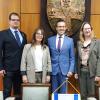
The first Water Resilience Forum — focusing on Europe’s key issues of water security and climate adaptation — was held on 8 December in Brussels by the European Commission, in cooperation with the European Economic and Social Committee and the Committee of the Regions. At the large-scale event – attended by EU decision-makers, industry leaders, scientists and civil society organisations – the University of Pécs was represented by Balázs Borkovits, Deputy Head of the International Grants and Project Management Department at the PTE Chancellery’s Directorate for Grant and Project Management, who presented the University’s SpongeCity project.
The aim of the Water Resilience Forum is to identify shared directions for action in the implementation of the EU’s water security goals planned for 2050, following the adoption of the European Water Resilience Strategy. One of the event’s key topics was urban water retention and urban adaptation to the effects of climate change, to which the SpongeCity project led by the University of Pécs contributes with pioneering solutions. In our interview, we asked Balázs Borkovits about the project’s results so far and their future plans.
Please briefly summarise the essence of the SpongeCity project.
The aim of the SpongeCity project is to help cities reduce both the frequency and the impacts of the increasingly common and severe extreme weather events – flash floods, heatwaves and droughts. The consortium is coordinated by the University of Pécs, and the professional work is supported by researchers of the Faculty of Science under the leadership of Dr Szabolcs Czigány and Dr Ervin Pirkhoffer. Our basic principle is that the impact of weather anomalies can be reduced if, contrary to earlier planning practice, cities do not drain away but instead retain and utilise rainwater. In this way, they protect themselves simultaneously against flash floods and water scarcity, reduce the risk of the formation of urban heat islands, and improve air quality.
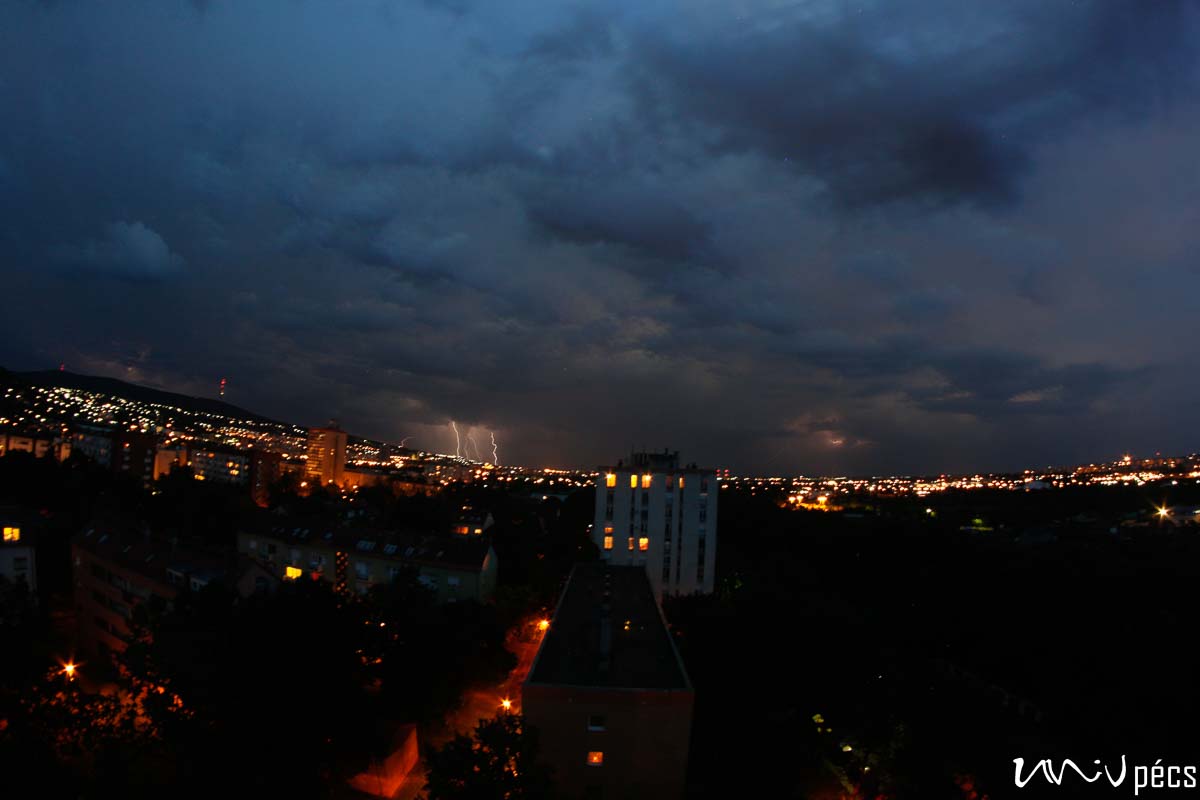
The essence of the “sponge city” methodology is to transform the urban environment so that it is able to absorb and retain rainwater naturally. This means that instead of the previously customary “grey infrastructure” – such as drainage systems and concrete surfaces – green, nature-based solutions should be prioritised. These include, for example, green roofs and green walls, rain gardens, permeable pavements, or water-retentive trenches.
The SpongeCity team provides various measurement data, digital tools, professional guidelines and ideas to support the planning of urban investments. Our work is supported by the Danube Regional Programme, and therefore the project covers the Danube Region programme area, that is, 12 countries from Austria to Moldova.
What progress has been made since the project’s launch in January 2024?
The first step was to select one test settlement in each country, where we carried out surveys. This was followed by the preparation of a comparative study showing how the morphological characteristics of different cities, their rainfall distribution, and their water and sewage systems influence their possibilities of adapting to climate change; and to what extent sponge city-type solutions are currently applied. We can say that they are almost not applied at all, which is why we collected data on successful investments and, based on these, began developing local action plans for the test cities.
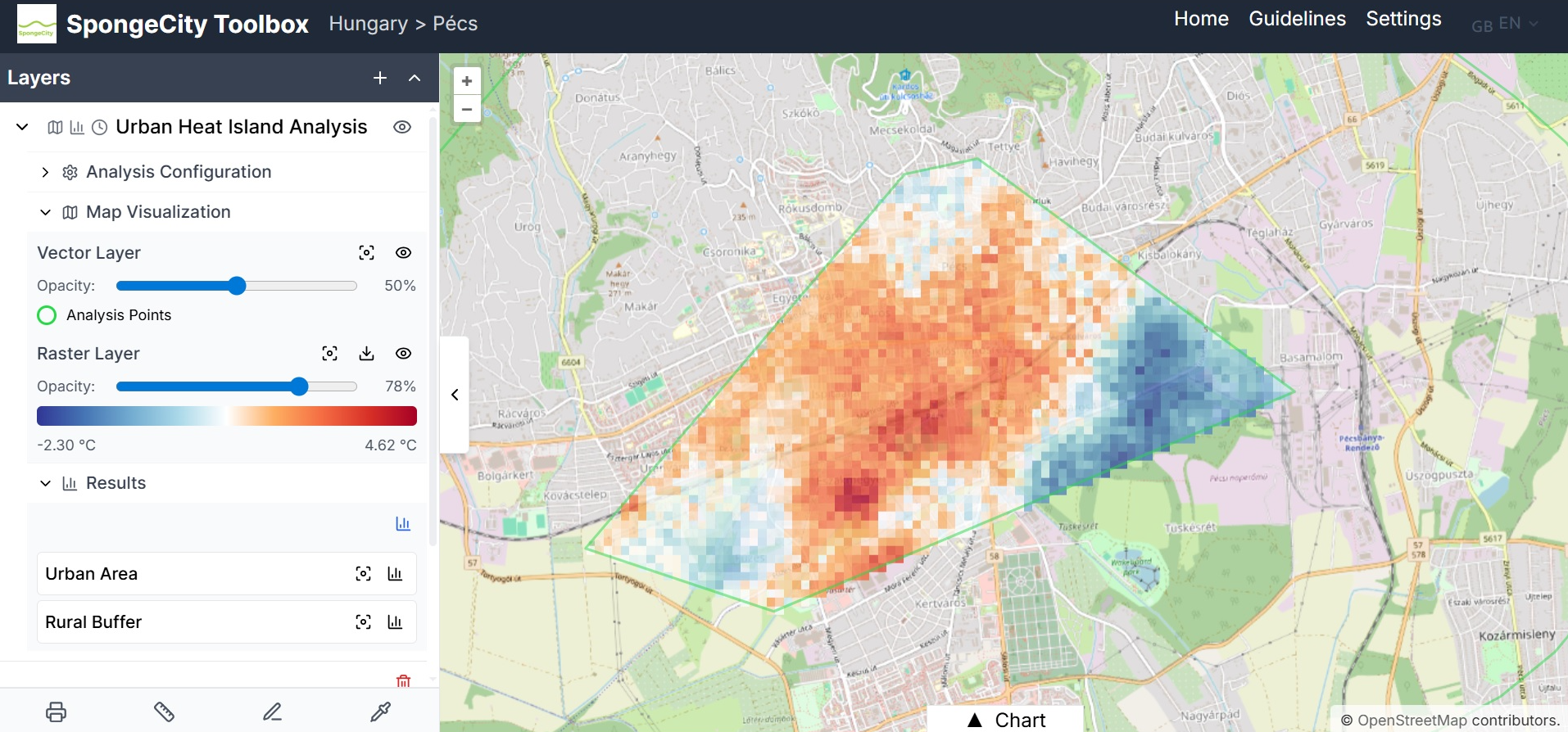
For the risk classification of the individual urban areas and the identification of locations for interventions, our Austrian partner, the researchers of Paris Lodron University Salzburg, customised for the project an online system they had developed, which analyses land cover changes using satellite imagery. This tool analyses and integrates climate, surface and land-use data, and makes it possible to examine urban heat islands, green spaces and water retention opportunities. We have made this online system available to all 12 test settlements.
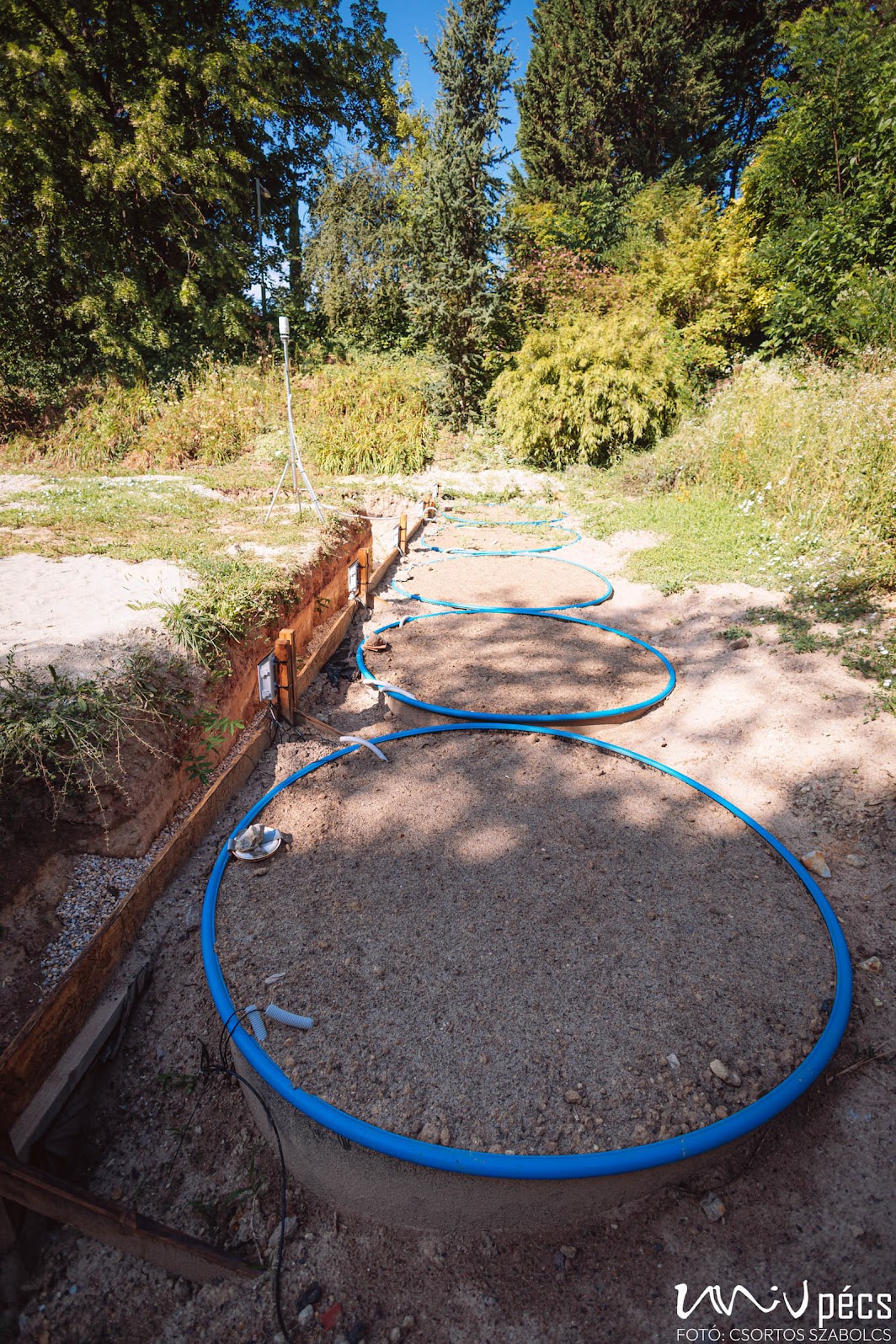
We would also like to present sponge city investments in a tangible way, which is why researchers of the Faculty of Science have built an experimental rain garden in the PTE Botanical Garden. Here, using sensors, they examine which soil mixture provides the most efficient water retention, taking into account the climatic characteristics of Pécs. Based on the results, the University will be able to make recommendations for the establishment of rain gardens in the urban areas of Pécs. An exact replica of the Pécs rain garden will also be built by our Croatian, Slovenian and Romanian partners, and their measurement data will be comparable in a cloud-based system. The Croatian team has already completed the work in Koprivnica.
What further plans do you have for SpongeCity?
We have eight months left of the project. During this period, a feasibility study for a sponge city investment in Pécs will be completed, which will be selected from the action plan by the municipality’s experts. We are also planning to organise numerous public and school events, and we will provide training for municipal professionals regarding the planning and implementation of sponge city investments. We undertook to train fifteen settlements within the project, but due to the high level of interest, we are likely to exceed this number.
I would also like to emphasise the importance of professional cooperation. In connection with the surveys, the preparation of the action plan, and the identification of possible interventions for Pécs, we work closely with the Urban Management Department of the Mayor’s Office and the experts of Biokom, as they are well acquainted with the areas most exposed to water-related damage, the reports submitted by residents, and they are the ones who can influence the city’s water management investments.

The SpongeCity project has recently achieved significant international success. In October, the Food and Agriculture Organization of the United Nations (FAO) recognised it for its activities in resilient land, soil and water resource management, and we were also given the opportunity to present our work in Rome at the Rome Water Summit. On 8 December, at the request of the European Commission, we presented the project in Brussels at the Water Resilience Forum. These invitations reinforced our conviction that we must continue to promote the sponge city methodology even after the closure of the project, and therefore we have begun developing the next project, which will support the establishment of an urban alert system and the preparation of further green investments.


- Log in to post comments
News





Faculties
University of Pécs
International Centre | Rector's Cabinet
H-7622 Pécs, Vasvári Pál str. 4.
+36-72/501-500/61682


University of Pécs | Chancellery | IT Directorate | Portal group - 2020.